September 2026. Research note. Sample figures throughout.
The Balance Field
$0a month saved, the $118k borrower
$0a month saved, the $400k borrower
A $118k borrower saves about $38 a month by refinancing half a point lower. That arithmetic is the low balance story, and it has a price.
Reading time line: About 5 minutes.Sample figures throughout
Every prepayment story is a story about a decision someone has not made yet. The low loan balance story is the simplest one in the market because the decision comes down to arithmetic a borrower can do on a napkin, and the napkin says no more often when the loan is small. This note walks the arithmetic, then the screen, then the price the story can carry, then the rate at which it cannot.
The arithmetic of a small loan
Take two borrowers with the same 6.25 percent note rate, offered a refinance at 5.75. One owes $118k. The other owes $400k. On a thirty year schedule the first borrower's payment falls from about $727 to about $689, a saving of about $38 a month. The second borrower's payment falls from about $2,463 to about $2,334, a saving of about $129.
Now add the cost. Closing a refinance runs to a few thousand dollars in most states once appraisal, title and lender fees are in. Call it $4,000 for both. The $400k borrower earns it back in about 31 months. The $118k borrower needs about 105 months, nearly nine years, and most people do not expect to be in the same house for nine years. So one borrower calls the lender and the other does not, and neither is being irrational.
Two payment bars, break even at 105 and 31 months.
The lender side compounds it. A loan officer earns more on the larger loan for the same hours, so the solicitation goes to the $400k balance first. The small borrower is both less motivated and less pursued.
That is the whole story. It is not about credit, geography or sophistication, although all three correlate with balance and muddy the read. It is about a fixed cost divided by a small saving.
The screen: under $125k, seasoned eighteen months
screen low_loan_balance v3where balance < $125kand seasoning >= 18 monthshits 146 / 9,240note Counts illustrate one month and are not a guarantee.
On the desk the story becomes a screen with two conditions. Average loan balance under $125k, because that is roughly where the break even stretches past the length of time most borrowers expect to stay put. Seasoned eighteen months, because a pool that young has passed the early ramp in which speeds rise for reasons that have nothing to do with balance, and because eighteen months of history is enough to see whether the pool has actually behaved the way the balance says it should.
In the sample month on this site, that screen returns 146 hits out of 9,240 pools disclosed. Counts illustrate one month and are not a guarantee. The pool on the Name screen is one of them: $118k average balance, weighted average credit score 762, concentrated in two slow states, printing 7.4 CPR over three months against a cohort at 10.3. CPR is how fast borrowers prepay, annualised. That is 2.9 CPR under the cohort, and the six print history shows the gap has been there all along rather than arriving last month.
Two of those fields deserve a hedge. A high credit score cuts both ways: it means the borrower can refinance easily if the saving is ever worth it. And a concentration in slow states is a fact about turnover, not about balance, so part of the 2.9 belongs to geography and would be there at any loan size.
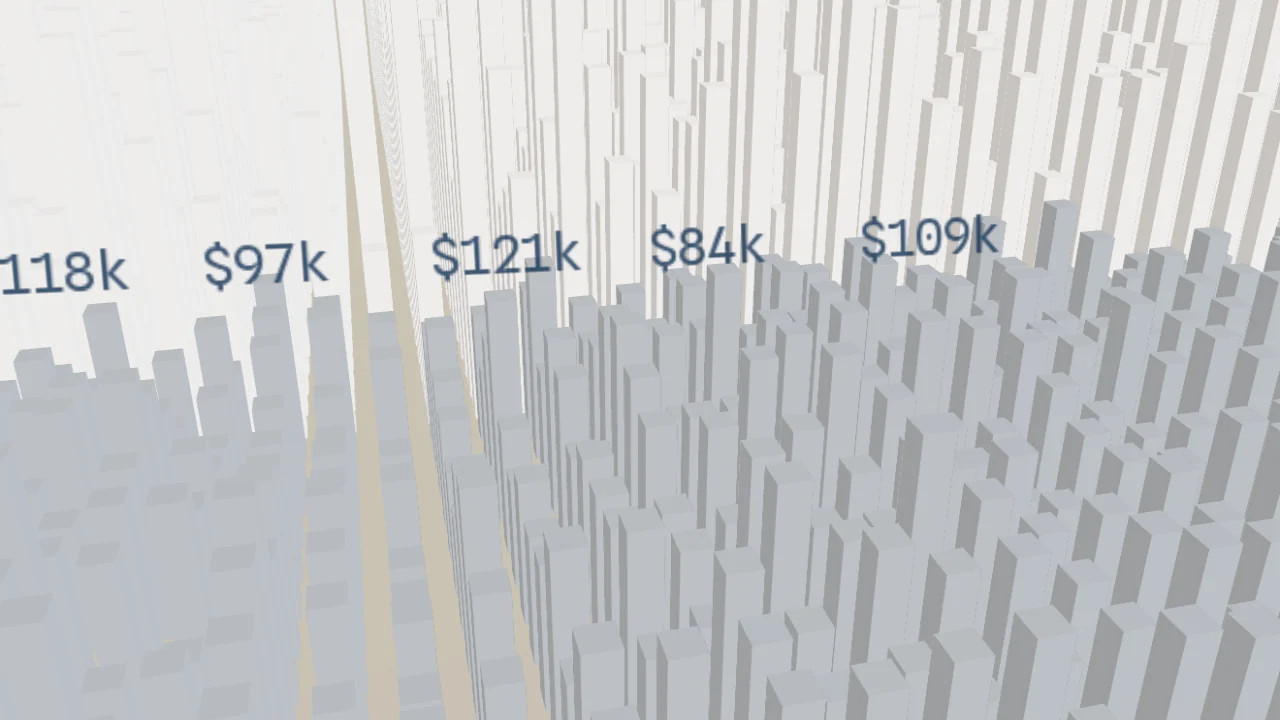
Four thousand strips, heights by balance. The dive lands in the under $125k band.
What a balance story can justify
A napkin, a pencil, a short column of figures. Sample photograph.
Payup is what a hand picked pool earns over the generic price, and it is quoted in points and 32nds, so 1-08 is one point and eight ticks, or 1.250 in decimal. A balance story justifies a payup to the extent that the slower speed is worth something to the investor in a premium bond, and it is worth more when the coupon is higher above current rates, when the gap to the cohort is wider, when the balance band is lower, and when the horizon you expect the story to survive is longer.
The calculator on this site takes those five inputs and returns an illustrative payup in ticks. It is deliberately a simple product of factors with the working shown, so a committee can attack a specific factor rather than a number. Run the sample pool through it and you get a figure, and beneath the figure a second one in a different colour, which is the point of the next two sections.
What it cannot justify
A balance story cannot justify a payup on a pool that has not printed slow.
It cannot justify a payup that assumes the balance is permanent either.
And it cannot justify treating the whole gap as balance when the pool carries other slow characteristics.
A balance story cannot justify a payup on a pool that has not printed slow. The arithmetic says small balances should prepay slower; the disclosure file says whether this pool did. If a pool sits under $125k and prints in line with its cohort for six months, the story has already failed for that pool, and a payup paid on the theory rather than the print is paying for a hypothesis.
It cannot justify a payup that assumes the balance is permanent either. Balances fall. A pool seasoned eighteen months at $118k will be a lower balance pool in three years by amortisation alone, which helps, but a run of curtailments or a few large payoffs can move the average faster than the schedule.
And it cannot justify treating the whole gap as balance when the pool carries other slow characteristics. Split the gap. Attribute what you can to geography and seasoning. What is left is the balance story, and it is usually smaller than the headline.
The rate move that makes it wrong
48bp of rally
Return to the napkin. At a half point of incentive the $118k borrower saves $38 a month and stays put. At a full point, refinancing from 6.25 to 5.25, the saving is about $75 and the break even falls to about 53 months. At a point and a half it falls further, and at some point in the rally the small borrower's arithmetic starts to say yes, the lender's solicitation reaches down the balance ladder because the larger loans are already done, and the gap to the cohort begins to close.
Under the illustrative sensitivity used on this site, a 2.9 CPR gap closes with a rally of about 48 bp. That is not a forecast of rates. It is the size of the move at which this particular story stops paying, stated so a committee can decide whether it is comfortable with it. Every memo on the desk ends with that number, and this one does too.
Smart Augment publishes research. This note is not investment advice, and model output is an estimate.
Research outputs for the customer's own investment professionals. Not a recommendation, an offer or a solicitation. Models are estimates. Figures derive from official agency disclosures and public market data.
Run the sample pool, or your own, through the Payup calculator. Platform runs the low balance screen on the whole disclosed universe every month.